Research Data Management
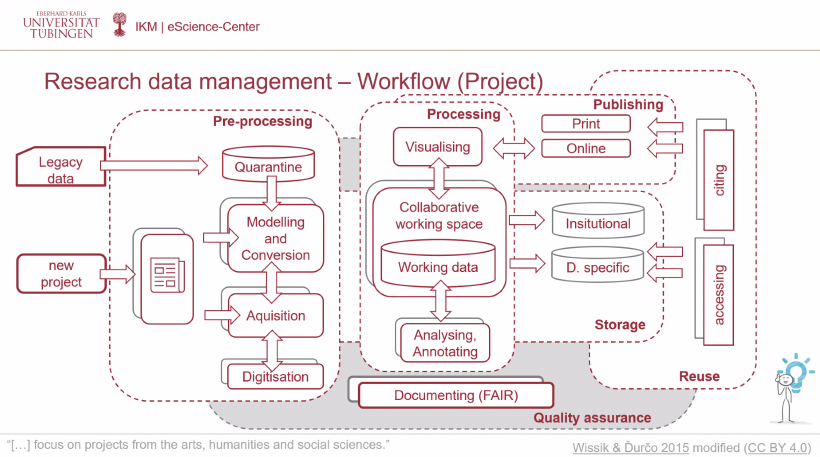
Research data management (RDM) efers to the process of organising the collection, processing, storage and publication of research data.
#RDM Implementation Guidelines for HIH Group Leaders
Guidelines for good scientific practice demand an existing sophisticated and reliable research data management.
Unlike common thinking the usage of technology is not the first step in implementing a sustainable RDM. A prerequisite is much more a so-called “Data Governance” guided by three main questions:
- Is it clear, which data should be stored in which form at which location?
- Is it clear, how data can be described to ensure retrievability and future use?
- Are the responsibilities clear of who is to ensure the above standards?
We here suggest five steps to systematically implement in your working group a sustainable RDM that considers these questions:
Implementing RDM Guidelines (PDF, 184.72 KB)
#RDM in a Nutshell
The most important aspects:
- Planning: contact the research support unit; refer to the DFG checklist; use the university's text modules
- Generating: create a data management plan (DMP) with RDMO
- Analysing & Processing: contact HIH IT core facility or an appropriate core facility of the university or medical faculty and/or NFDI consortium; seek advice on specific topics
- Publishing: contact the university library if you have any questions
- Archiving: talk to HIH IT core facility, the ZDV or GB-IT about suitable storage solutions
- Re-using: use FDAT or a discipline-specific repository of your choice
#Available IT-Services related to RDM
- HIH Fileserver
- Data Archiving
- Repositories
- RDM Course for Postdocs & Professors. The presentations of the previous course round are also available here.
- Research Data Management Organiser Tool (University Tübingen): Guided semi-automatic creation of data management plans.
#DFG Checklist for RDM
- Data description
How does your project generate new data? Is existing data reused? Which data types (in terms of data formats like image data, text data or measurement data) arise in your project and in what way are they further processed? To what extent do these arise or what is the anticipated data volume?
- Documentation and data quality
What approaches are being taken to describe the data in a comprehensible manner (such as the use of available metadata, documentation standards or ontologies)? What measures are being adopted to ensure high data quality? Are quality controls in place and if so, how do they operate? Which digital methods and tools (e.g. software) are required to use the data?
- Storage and technical archiving the project
How is the data to be stored and archived throughout the project duration? What is in place to secure sensitive data throughout the project duration (access and usage rights)?
- Legal obligations and conditions
What are the legal specifics associated with the handling of research data in your project? Do you anticipate any implications or restrictions regarding subsequent publication or accessibility? What is in place to consider aspects of use and copyright law as well as ownership issues? Are there any significant research codes or professional standards to be taken into account?
- Data exchange and long-term data accessibility
Which data sets are especially suitable for use in other contexts? Which criteria are used to select research data to make it available for subsequent use by others? Are you planning to archive your data in a suitable infrastructure? If so, how and where? Are there any retention periods? When is the research data available for use by third parties?
- Responsibilities and resources
Who is responsible for adequate handling of the research data (description of roles and responsibilities within the project)? Which resources (costs; time or other) are required to implement adequate handling of research data within the project? Who is responsible for curating the data once the project has ended?
DFG checklist RDM (PDF, 29.99 KB)
- University Hamburg: DFG checklist supplemented with comments (German)
- University Hamburg: DFG checklist supplemented with comments (English)
#Research Data Management as a Process
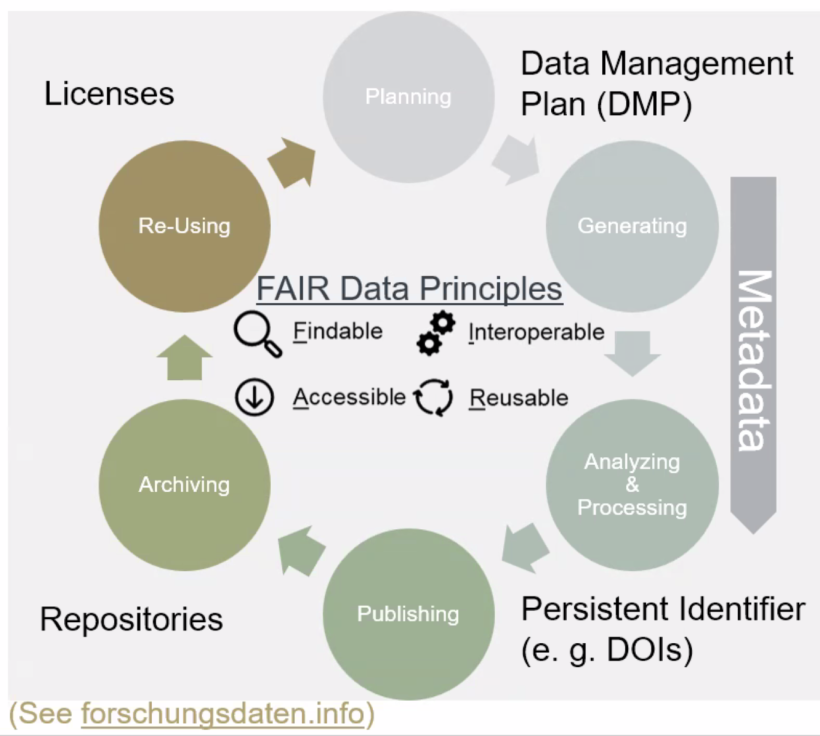
#Example for Research Data Pipeline Flowchart